Table of Contents
Open Table of Contents
Introduction
Perplexity recently announced $1B in annualised revenue. I started digging in, because it is a fascinating journey: from an answer engine over web data, a use case that is fast becoming a commodity, to a business at this scale. Press reports say it started 2026 below $250M and crossed $750M by August.
So where is the money coming from, and what can a product person learn from it? This post is my attempt to answer that, followed by a few ideas of my own on how to grow revenue even further.
Two caveats. “Annualised” is a run rate (current revenue extrapolated over a year), not recognised revenue. And Perplexity has not published a breakdown by product, so this is my read of public information, not insider data.
The shift: from answer engine to trusted workflows
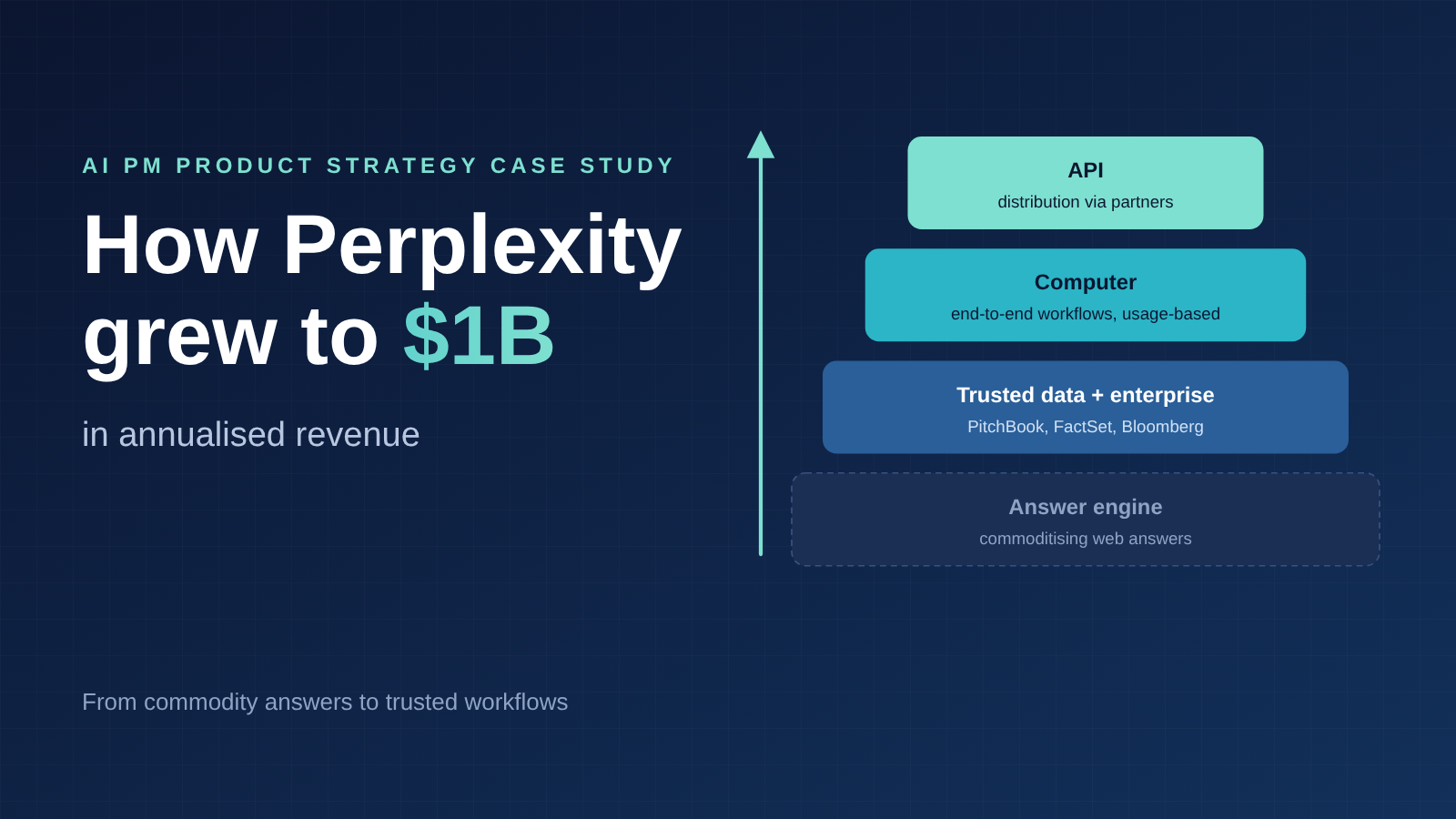
Perplexity started as an answer engine: search infrastructure plus LLMs, giving cited answers over web data. Good, but consumers can now get that almost anywhere. Here are the key steps I see in how it moved up:
- Chose the right customer. It focused on people who need trustworthy, source-backed answers (finance, VC/PE, consulting, GTM teams), not on the casual consumer who just wants a quick answer.
- Added trusted, proprietary data. Partnerships with sources like Bloomberg, FactSet, PitchBook, Statista and Crunchbase. Anyone can search the open web, but not everyone can search licensed data.
- Moved from answers to completed workflows. With Computer, the job is end-to-end research (analyse a company, produce the report), not a single answer. Finance shows this well: trusted data connectors, repeatable workflows like company tearsheets and sourcing screens, source traceability, and integration into Excel, Teams and the Agent API.
- Used the API as distribution. Instead of acquiring every customer itself, Perplexity lets companies with their own distribution build on its intelligence. Their usage becomes its revenue.
The result is a portfolio that monetises in four ways:
- Consumer subscriptions (answer engine on web data)
- Enterprise / team subscriptions (answer engine on trusted data)
- Computer: usage-based credits for end-to-end workflows
- API: companies building intelligence products on top
Key takeaways for product strategy
1. Commodity use cases cap revenue. When every competitor gives a decent cited answer for free, you cannot charge much for it. Growth came from moving to customers who pay for trust.
2. Sell the job done, not the answer. An answer is a feature. A finished tearsheet or investment memo is a completed job, and a completed job can be priced on usage and value. That is why Computer’s credit model works.
3. Differentiation gets the sale, defensibility keeps the customer. This is the lens I find most useful. My rating of Perplexity’s advantages:
| Advantage | Defensibility |
|---|---|
| Source-backed AI answers | Low |
| Access to financial-data partners | Medium |
| Proprietary search infrastructure | Medium |
| Enterprise integrations and workflows | Medium to high |
| API integrations into customer products | Medium to high |
Imagine a private equity firm using Computer every day to screen targets with licensed PitchBook data, apply its own investment criteria, generate standard investment committee memos, and store reusable workflows. After six months, switching to ChatGPT means recreating integrations, workflows, permissions, templates and accumulated memory. The more embedded the product, the harder it is to replace. The levers that grow revenue here are the same ones that build the moat.
4. Let partners carry distribution. The API turns customers’ existing reach into Perplexity’s growth, with no acquisition cost.
My ideas to grow revenue further
I start the way I always do, with the growth equation, so every idea maps to a variable I can move:
- Consumer = free users × conversion rate × ARPU
- Business = customers × avg. seats × ARPU + usage-based revenue
- API = customers × billable usage per customer
- …minus churn
Revenue grows in three ways: acquire new customers, expand revenue from existing ones, or reduce churn. I prioritise on impact, margin, confidence, effort and speed. My bias: for a fast uptick, start with expansion revenue. The customers and trust are already there, while new-customer acquisition is slower and costlier.
Here are the top four opportunities I would explore:
1. Free-to-paid conversion. Give free users a small bucket of Computer credits so they feel an end-to-end workflow. Workflows burn credits fast, which creates a natural upgrade moment. Pair it with time-limited Pro/Max trials for high-intent users (people researching companies and financials), and contextual nudges such as “you analysed five companies, want this as a weekly report?”
2. Cross-sell. Ask which unsolved problem an existing customer has that another product could solve. Intent signals point the way: enterprise search users running company research → Computer; enterprise accounts building internal tools → API. Size it as eligible customers × attach rate × incremental ARR.
3. Upsell. Find power users and customers hitting limits, then offer higher tiers with better models, more quota, more trusted sources, more connectors and indexing of internal company knowledge. That last one raises switching costs too.
4. Usage-based growth on Computer. Get customers to run more workflows, more often, on bigger jobs: recurring workflow templates, templates a teammate can remix and the next team can adopt, and longer-running deep research. It compounds, because more usage means more embedded workflows, higher switching costs and lower churn.
What would you prioritise differently? I would love to hear your take.
Sources: the $1B run-rate comment was made by Perplexity’s CEO on November 16, 2026, as reported in press coverage (FourWeekMBA, AI Magazine). The growth trajectory comes from reports by The Information and the Financial Times. These are company claims and press-reported figures, not audited results.